Posted by Rhys Ursuliak (9)
Wednesday, November 30, 2011
Monkeys Mother Wingmen
How often do you find your mother setting you up with a date? For a young male muriqui monkey of Brazil, his mother is the best wingman he could hope for. Troops of muriquis are led and run by a matriarch. This older female can live upwards of thirty years, and governs the mating that happens within her troop. Because of this, there is no competition for male dominance in mating. Instead, the matriarch's policy seems to be "everyone gets a share." Although some males are preferred and will have greater reproductive success, all the males will get the chance to pass their genes along. This raises the question: "if everyone has a chance to pass on their genes, doesn't that take natural selection out of the picture?" If the males are not competing or being selected for, then detrimental traits could be passed along, harming the overall population. This species is severely endangered, so this could be part of the reason.

"High Five!" Cried the Raven

RAVENS use "HAND" GESTURES to COMMUNICATE
If I asked you what a wing was for, chances are you would tell me it helped birds fly. Would you ever think that a wing, which has the same basic anatomical bone structure of the hand that any animal with an actual hand has, could use its wing to make gestures, as well? A recent study has shown that ravens use their beaks and wings similar to the way humans use their hands, and can perform gestures such as pointing to objects. Until now, this behavior has not been seen by scientists in anything other than primates. Although dogs have been observed to point to things, they were excluded as a possibility, since they are taught this action by humans. Even when considering primates, gestures comparable to those of humans are rarely seen. One instance where such a gesture has been seen is in Uganda, where chimpanzees use directed scratches to point out parts of their body they would like groomed.
With more and more research, ravens have been found to be extremely intelligent creatures, out-competing with apes in some cases. Biologists have found them to be a very object- oriented species.
Research involving ravens has shown that they use their beaks to motion to and offer items, like moss, stones and twigs, which often leads the gestured to look at the object. Those gestured are commonly members of the opposite sex. The two would then interact directly, maybe by clasping their bills together or jointly manipulating the item. This has suggested that these gestures are used to measure interest of a partner or to reinforce bond strength. This has completely blown the expectation of what a "gesturer" should look like, considering that the raven has wings instead of hands, a beak and is able to fly, yet can still take advantage of nonvocal communication in this way.
It is a fact that ravens possess a high level of cooperation between partners, which suggests that gestures evolve in species that demonstrate a high degree of collaborative abilities. This discovery could open new possibilities on the origin of gestures within humans. One thing is certain, further research must be done on the other various gestures of ravens in order to make connections between function and meaning that could shed light on our own species' development.
http://www.livescience.com/17213-ravens-gestures-animal-communication.html
Posted by Chelsea Van Thof (9).
Platypus Electroreception
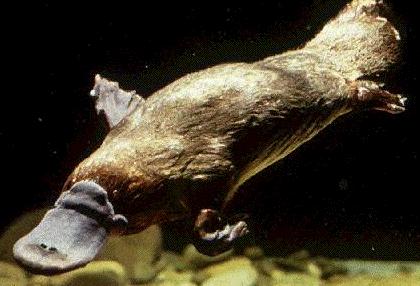
What do you call a cat-sized, venomous, egg-laying semi-aquatic mammal with the bills of a duck, the tail of a beaver, and the feet of otters? When European naturalists first encountered the platypus, they thought that it was an elaborate conspiracy against science. All oddities aside, platypuses are ones of the only mammals that are able to use electroreception (the only other one is the echidna, or spiny anteater). The platypus has the most sensitive sense of electroreception out of all the mammals, and the receptors are located in their bills. They swim in a characteristic side-to-side motion because they are able to determine the direction of any electrical source (this, of course, works better in water). Electroreceptors in the bill are coupled with mechanoreceptors to perceive both electric signals and tactile ones. Tiny pressure pulses are detected by the bill, which direct the platypus to its prey. To feed, the platypus will dive to the bottom of the stream and dig with its bill. When tiny electrical signals are detected by the muscular contractions of organisms are detected, it will then close in on its prey. Experiments with robot shrimps sending out electrical signals have also triggered this response. These mammals are unique in that it feed by neither sight nor smell. They also possess spurs in their hind legs that inject a venom causing tremendous pain to mammals as big as humans. They also store food in their cheeks while preying, similar to squirrels. These mammals make centaurs and unicorns look normal.
http://www.animalcorner.co.uk/venanimals/ven_mammalsPlat.html
Posted by Michael Shi
Lyre Birds
http://www.cracked.com/article_19483_5-birds-with-abilities-that-put-superheroes-to-shame.html
So I know the link I have above isn't the most scientific reference , but this bird is quite fascinating. The Lyre bird is able to mimic any sound it hears. This is truly remarkable considering we went through examples a couple weeks ago where if a bird does not hear the correct song, the song can get distorted. The lyre bird's main song is a mixture of seven elements of its own song and any number of other mimicked songs and noises. They are able to mimic other animals as well such as koalas and dingos. The lyre bird's have the most complex syrinx compared to other songbirds. This allows for it to have unmatched mimicry. Lyre Birds will hear any noise and incorporate those notes into their songs.
The question then remains , how is it that the lyres are able to process all these notes and still be able to recognize their own species calls. Since each lyre may hear different things, each song must be very unique from each other.
Posted by Jobin
Tuesday, November 29, 2011
Poison frogs color evolution
 Individuals of the same species, poison dart frogs, can vary greatly as far as color patterns go. Color patterns seen in a population depend on where the frog lives.
 Researchers from the University of Montreal performed a study in Peru using decoy frogs. They placed 3,600 clay frogs painted three different colors in different spots.
"In the highlands of the Cainarachi Valley there, the frogs are splashed with a green undulating pattern, almost like an abstract snakeskin pattern. In the lowlands only 6 miles (10 kilometers) away, the same species of frog boasts yellow stripes instead."
Frogs that had been painted to look like locals were much less likely to be attacked by predators, because the predators know frogs marked like that are poisonous. Frogs of the same species with different color patterns were twice as likely to become prey. Because the local frogs are known to be poisonous they are not chosen as prey and and much more likely to reproduce, spreading their color pattern.
The fact that color patterns varied so much in populations so close together I found particularly interesting. Also, the rate at which the predators learned that the decoy frogs do not make a good meal was also very surprising, as most of the attacks on the decoys had happened within a day of them being placed.
Wednesday, November 23, 2011
SEX WITH A BEER BOTTLE?
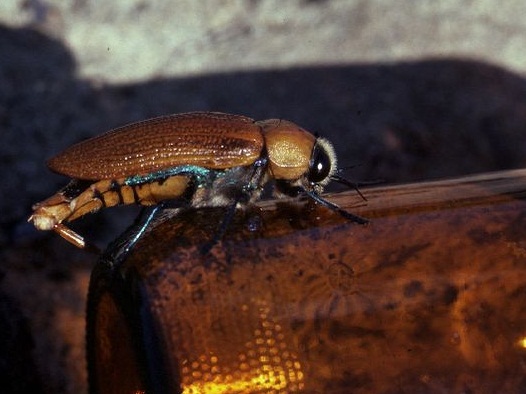
Beetles are dying while trying to get it on with discarded brown beer bottles, according to research conducted by Darryl Gwynne, a University of Toronto Mississauga professor.
It's a case of mistaken attraction, because the beer bottles happen to possess all of the features that drive male Australian "jewel beetles" wild. They're big and orangey brown in color, with a slightly dimpled surface near the bottom (designed to prevent the bottle from slipping out of one's grasp) that reflects light in much the same way as female wing covers. As a result, the beer bottles are irresistible to the male insects, which will die trying to mate with them in the hot Australian sun.
The bottles resemble a "super female" jewel beetle. Male beetles are so captivated by the bottles that they will gird their loins and go through the expected motions, refusing to leave until they fry to death, are consumed by hungry ants, or are physically removed by researchers.
The male beetles are very particular about the bottles. Beer cans or wine bottles do nothing for them. It's all about the shape, color and texture and has nothing to do with booze. As the researchers wrote in their findings, "Not only do western Australians never dispose of a beer bottle with beer still in it, but many of the bottles had sand and detritus accumulated over many months."
While the researchers obviously see the humor in all of this, there's a serious message too. The findings demonstrate how our garbage not only litters landscapes but can also directly affect the populations of other species. This also points out that the research supports a theory of sexual selection: that males of certain species, in their eagerness to mate, are often the ones making mating mistakes.
http://news.yahoo.com/why-beetles-sex-beer-bottles-q-scientists-200203561.html
Posted by Whitney Huynh (8)
Spiders give gifts and fake death for sex!
As we’ve started talking about sexual selection in class, I find it fitting that this week’s blog be about that very subject. In class, we mentioned how the male scorpion fly presents ‘gifts’ to the female, usually a dead bug, in order to distract her so the male can copulate for an extended period of time. Well, as it turns out, these flies aren’t the only one paying for sex. Pisaura mirabilis, also known as the nursery web spider, is European species who also present ‘gifts’ to females in order to distract them so they can copulate. While most males present fresh prey wrapped in silk, some just wrap shell husks in silk and present. Scientists believe the stress of finding a mate forces these males to present anything in order to have a longer copulation time. Researchers from Aarhus University in Denmark and the Instituto de Investigaciones Bioloìgicas Clemente Estable in Uruguay took 20 spiders and set them in groups and gave them gifts to wrap: either no gift, a shell husk, a fresh fly, or a protein-enriched fly. They found the males would wrap the present with silk until it was unidentifiable, giving them more time for copulation as the females would inspect the gift. As expected, males who presented gifts had greater success mating, and those with edible gifts got to mate for a longer period of time. What separates these spiders from other gift-giving species is the other trick they use to mate. If they haven’t copulated for a long enough time, some males will pretend to die, with their gift in hand. The females would then drag the male ‘carcass’ along in order to try to take the gift. Once they stop dragging, the males will revive and mate with the females for a second time (talk about desperate). This feigning death is called thanatosis. And we think human men can pull some weird crap when trying to get a girl.
Picture of male spider giving gift:

Information came from the article “8-Legged Sex Trick? Spiders Give Worthless Gifts, Play Dead” written by Jennifer Welsh on Nov. 13, 2011 from livescience.com. Link:
http://www.livescience.com/17010-spider-gifts-play-dead-mating.html
Posted by Austin Gray (8)
Picture of male spider giving gift:
Information came from the article “8-Legged Sex Trick? Spiders Give Worthless Gifts, Play Dead” written by Jennifer Welsh on Nov. 13, 2011 from livescience.com. Link:
http://www.livescience.com/17010-spider-gifts-play-dead-mating.html
Posted by Austin Gray (8)
Subscribe to:
Posts (Atom)